

THE MULTI-SITE MAINTENANCE GUIDE · 2026/2027
Everything you need to know to master maintenance across your sites.
Methods, regulatory obligations, provider management, budgets, CMMS and practical tools: 335 pages to organise, anticipate and manage your multi-site maintenance.
- 335pages
- 13chapters
- PDFfree
The guide is written in French.
 PDF · 335 pages
Save it to your computer so you can read it at any time, even offline.
A question or feedback from the field about the guide? Write to us at [email protected].
Written by the co-founders of Bob! Desk, with nearly 20 years of combined experience in multi-site maintenance.
WHY THIS GUIDE?
Managing maintenance across many sites can’t be improvised. But it can be learned.
Between emergencies, regulatory obligations, coordinating providers and keeping budgets under control, managing maintenance across a multi-site network is a real challenge.
The good news? There are methods, tools and best practices to get there.
This guide brings together the fundamentals of the job, practical advice and lessons learned from industry professionals to help you structure, optimise and better manage your multi-site maintenance.
CONTENTS
13 chapters to address your maintenance challenges.
Click a chapter to see its sections.
The guide follows the French regulatory framework, in particular chapter 4 (Regulations and compliance) and the regulatory calendar. The English edition will be adapted to local regulations.
- 1.1Maintenance fundamentals
- 1.2In-house or outsourced: the different set-ups
- 1.3Maintenance roles
- 1.4Sector-specific maintenance requirements
- 2.1The building and its equipment families
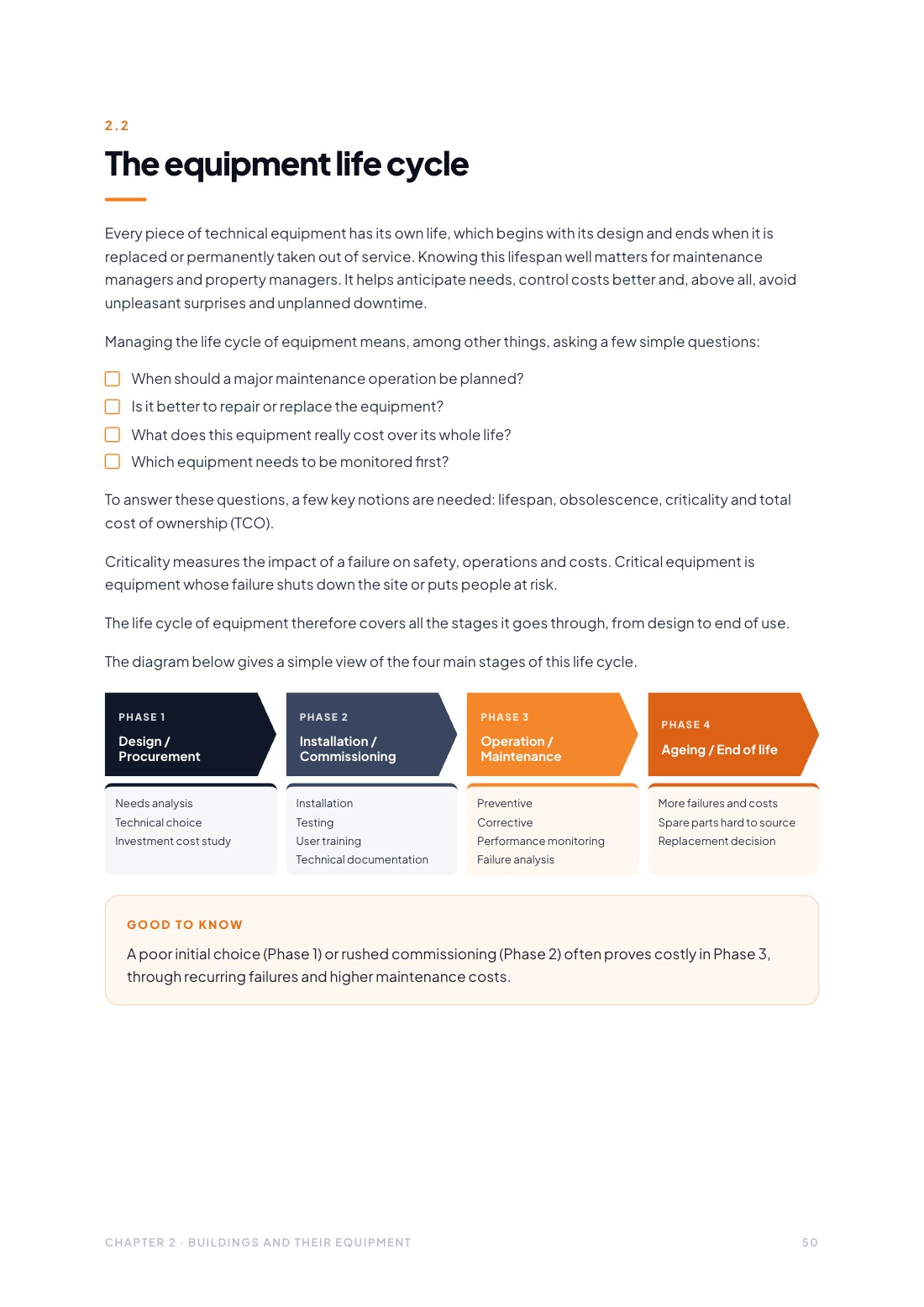
- 2.2The equipment life cycle
- 2.3Repair or replace: technical trade-offs
- 2.4Useful terminology
- 3.1Electrical
- 3.2Heating, ventilation and air conditioning (HVAC)
- 3.3Commercial kitchens: refrigeration, cooking and dishwashing
- 3.4Drainage and sanitary plumbing
- 3.5Locksmithing, access control, doors and roller shutters
- 3.6Lifts and goods lifts
- 3.7Fire safety
- 3.8Roofing, covering and waterproofing
- 3.9Finishing works, joinery and glazing
- 3.10BMS, building controls and automation
- 3.11EV charging points and solar PV
- 3.12Water management and sustainability
- 4.1Owner and operator responsibilities
- 4.2ERP: public-access buildings (France)
- 4.3Safety register
- 4.4Mandatory regulatory inspections
- 4.5Workplace safety
- 4.6Asbestos
- 4.7Legionella
- 4.8Disabled access
- 4.9Environmental and energy obligations
- 4.10Annual regulatory calendar
- 5.1Types of service providers
- 5.2Local or national providers: how to decide?
- 5.3How to select a provider
- 5.4Contracting
- 5.5Provider evaluation
- 5.6Building a high-performing network
- 5.7The client–provider relationship
- 6.1The life cycle of a work order
- 6.2Request management
- 6.3Emergency management
- 6.4Quote management
- 6.5Managing work order reports
- 6.6Acceptance and close-out
- 6.7Document management
- 6.8Lessons learned and continuous improvement
- 7.1Building a preventive plan
- 7.2Annual planning
- 7.3Regulatory contracts
- 7.4Maintenance contracts
- 7.5Analysing recurring failures
- 7.6Asset management
- 8.1Building a maintenance budget
- 8.2Cost analysis
- 8.3Intervention thresholds
- 8.4Quote analysis
- 8.5Maintenance purchasing process
- 8.6Contracting and negotiation
- 8.7Managing direct purchases
- 8.8Financial management
- 8.9ROI and trade-offs
- 9.1What is a CMMS?
- 9.2Key features
- 9.4Problems a CMMS solves
- 9.6Integration and benefits of artificial intelligence
- 9.8Specifications and tool selection
- 9.9Implementing a CMMS
- 10.1Key indicators
- 10.2Managing providers
- 10.3Budget management
- 10.4User satisfaction
- 10.5Multi-site benchmarking
- 10.6Building an executive dashboard
- 11.1Maintenance manager skills
- 11.2Leadership and communication
- 11.3Taking up the role: the 90-day plan
- 11.4Managing priorities
- 11.5Crisis management
- 11.8Advice from the authors
Answers to the most common questions and challenges of the job.
- 13.1Checklists
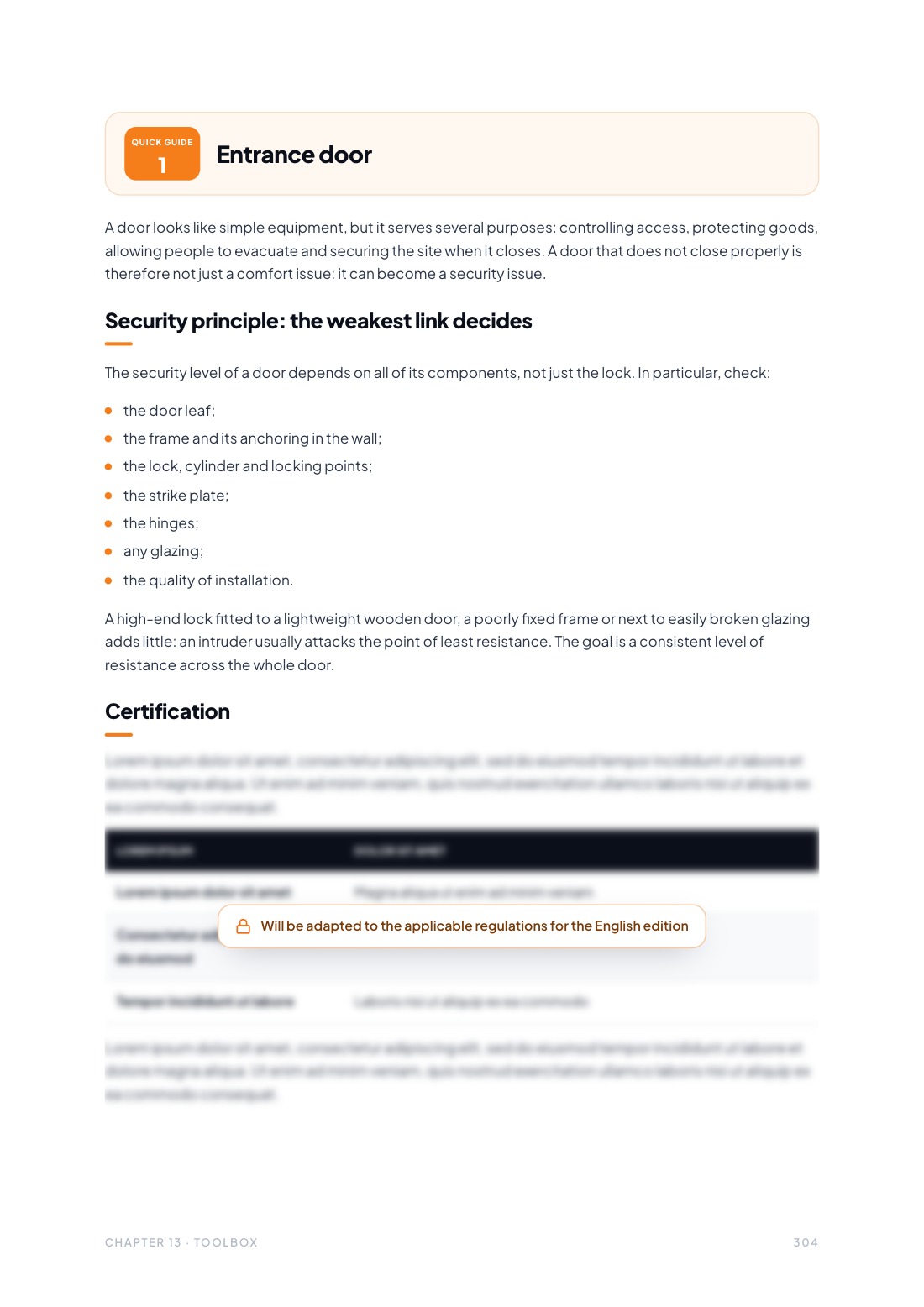
- 13.2Quick-reference sheets: 12 in-store equipment items
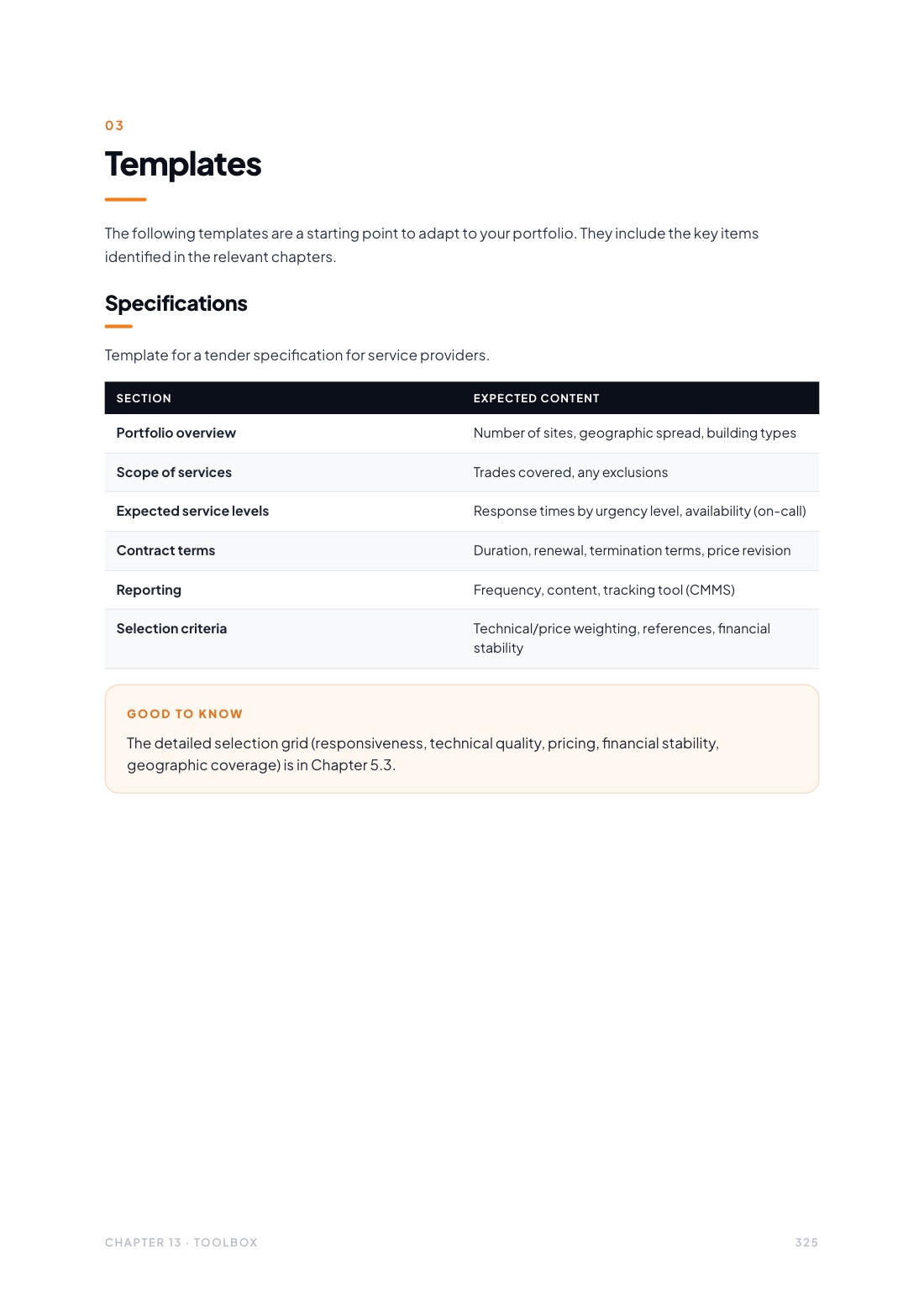
- 13.3Templates
- 13.4Dashboards
- 13.5Calendars
Understanding multi-site maintenance
INCLUDED IN THE GUIDE
The essential documents for your maintenance.
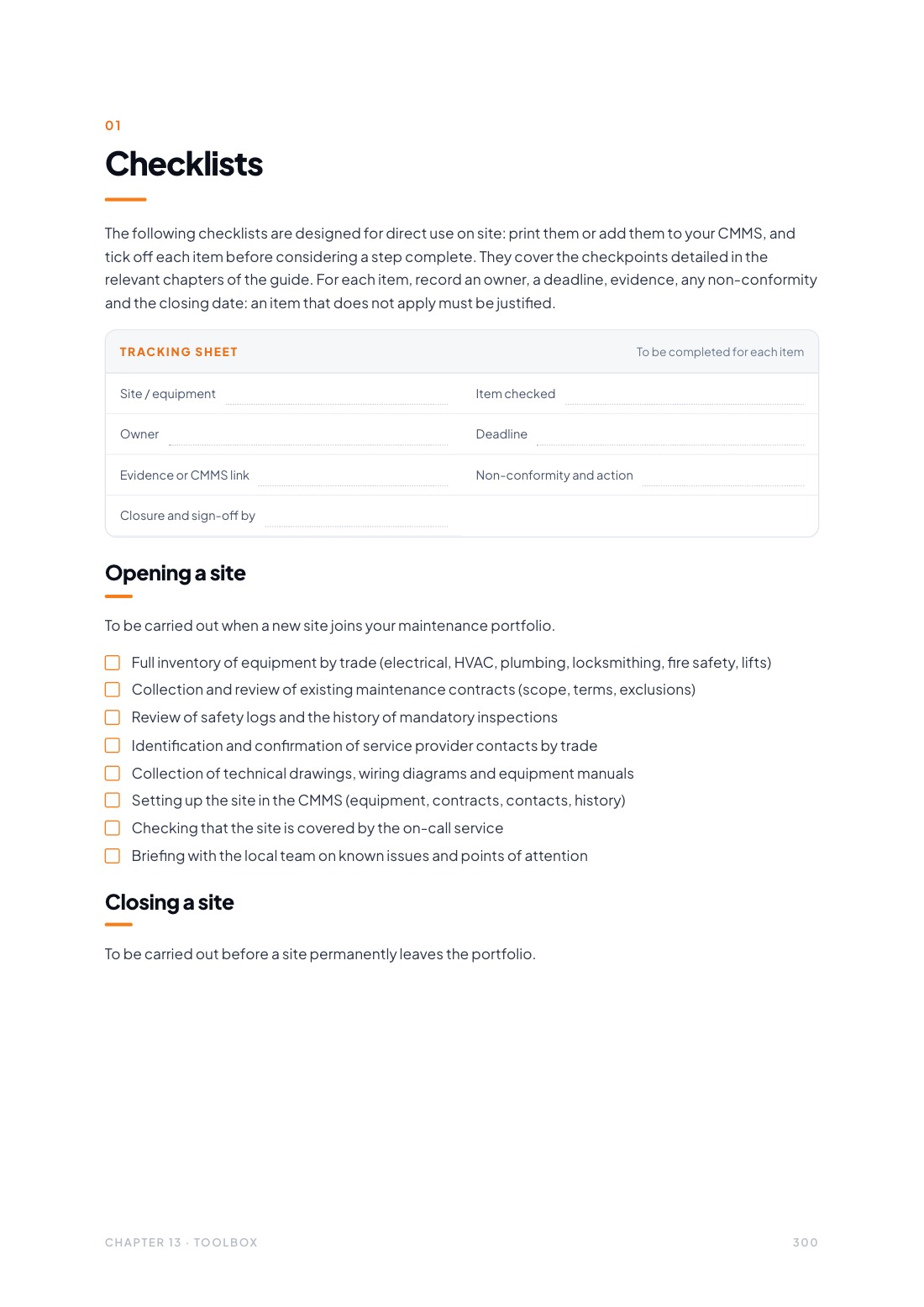
Checklists, quick-reference sheets, templates, dashboards and calendars: practical resources to organise your work orders, track your equipment and structure your maintenance.
PREVIEW
A preview of what's inside.
Diagrams, summary tables, calendars, indicators: six pages taken from the guide. Tap or click a page to view it full size.
Sample pages from the guide.
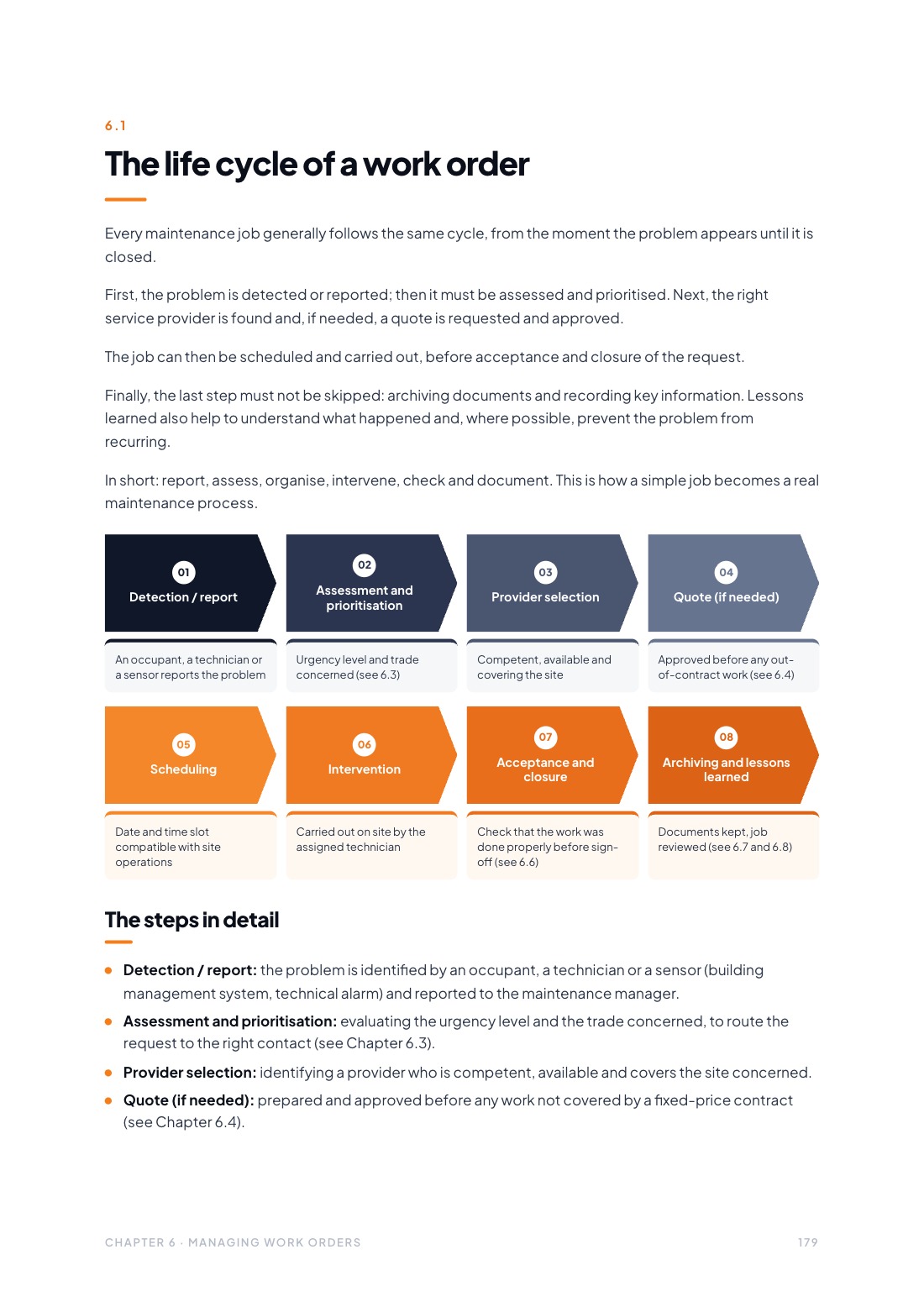
The life cycle of a work order
The eight stages of a work order, from detection to archiving and lessons learned, with each stage explained.
ROLES
Who is this guide for?
Whether you manage maintenance for your own sites or carry out work for your clients, this guide supports you in your day-to-day work.
THE PROFESSIONALS CONCERNED
Maintenance assistant / coordinator
Learn the fundamentals and build your skills.
Maintenance manager
Structure processes and coordinate work orders.
Technical / real estate director
Manage budgets, risks and performance.
Maintenance service provider
Optimise work and client follow-up.
SECTORS
- Retail
- Food service
- Hospitality
- Real estate
- Services
- Logistics
Networks from a handful of locations to several thousand sites.
THE AUTHORS
Expertise forged in the field.
Since 2015, the authors have built their experience alongside maintenance teams, service providers and multi-site networks. Together, they now have nearly 20 years of experience in maintaining distributed networks.
Several chapters benefited from contributions by members of the Club Enseigne & Innovation during a workshop held in 2025. Regulatory references checked on 29 and 30 September 2026 (French regulatory framework).



Make maintenance a subject you master.
Find the knowledge, methods and practical tools to better organise, anticipate and manage maintenance across your sites.
Free PDF · 335 pages · 13 chapters
PDF · 335 pages · Available in French